
Classic software needs unit tests. Prompt-based and agent systems need them even more—and they behave differently.
Language models are stochastic: a one-line prompt change can ripple across many paths. Fix case ten and you may silently break cases one and two. So meaningful changes require a wide retest across representative inputs and configurations, not a single happy-path check.
That is what offline evaluation infrastructure is for: you cannot improve what you do not measure.
Offline vs online evaluation
Offline evaluation uses controlled, replayable datasets to measure behavior and regressions. You define representative cases and labeled expectations, run the agent, score the results, and repeat the suite after changes.
Online evaluation measures behavior on real production traffic using telemetry, automated checks, product outcomes, and explicit user feedback. Typical setups capture tool calls and traces with OpenTelemetry and collect signals such as thumbs-up / thumbs-down or textual feedback for engineering and product teams.
Offline
Controlled, replayable datasets
Measure behavior and regressions before you ship—labeled cases, suite re-runs, deterministic graders, LLM rubrics.
Online
Real production traffic
Telemetry, automated checks, product outcomes, and user feedback (OpenTelemetry, thumbs-up / thumbs-down) for engineering and product teams.
Our product SigAgent.AI implements online evaluation for Claude agents. We will cover online evaluation in a later post.
This post focuses on offline evaluation.
The offline evaluation loop
We built the Smart Agent Kit for DocRouter’s Document Agent, a coding agent that configures schemas, prompts, and tags through a multi-tool agent loop.
The same basic pattern applies to many other agents:
- Define a dataset of representative tasks, tagged for segmentation and selective reruns.
- Define what “good” means using facts, reference solutions, and assertions / invariants.
- Run the agent offline, usually with 1..k trials per task, recording results, traces, cost, and latency.
- Score each trial with deterministic graders first, followed by LLM judge rubrics where semantic judgment is needed.
- Aggregate results per task and across the test run, then rerun the full suite—or only the affected slice—after changes.
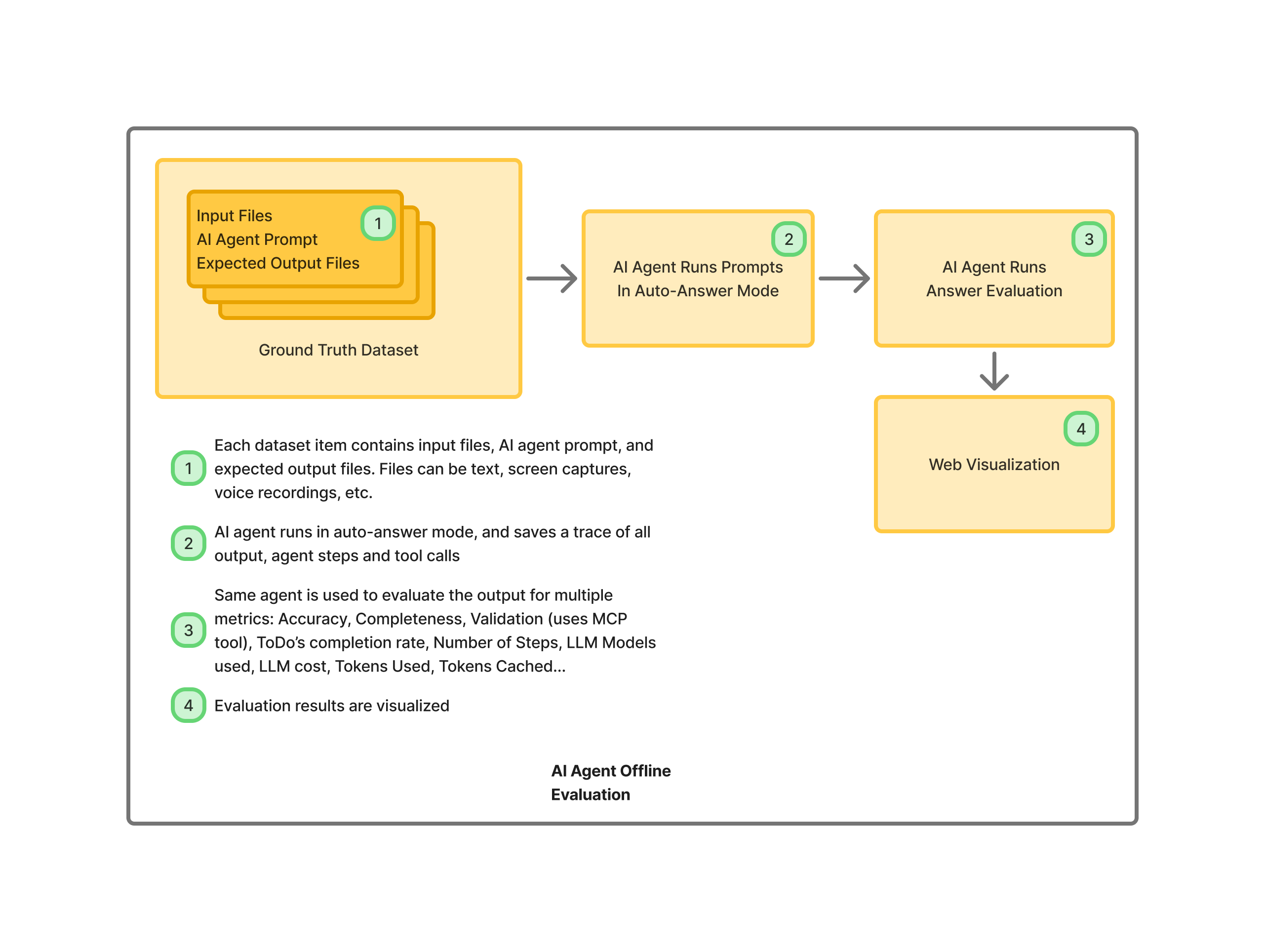
Figure 1: Offline evaluation: dataset → agent run → deterministic graders → LLM judge rubric(s) → scored results.
One pattern, two domains
Figures 2 and 3 use the same architecture:
Figure 2 shows the Smart Agent Kit, which we built for DocRouter’s Document Agent. Figure 3 applies the same pattern to a medical insurance coverage-assessment agent. The medical example is a design, not a product we have shipped.
Smart Agent Kit — evaluating DocRouter’s Document Agent
DocRouter’s Document Agent sets up document extraction in plain language. It uses many tools: creating and validating schemas, writing prompts, attaching tags, running extraction, and more.
Because this is a tool-using coding agent, chat fluency is not enough to tell us whether it worked.
The Smart Agent Kit (smaht-agent-kit) evaluates the actual outcome.
Figure 2: Smart Agent Kit — agent under test → dataset → tasks/tags → test run → 1..k trials → per-task evaluation → test-run / dataset aggregates.
The important pieces are:
- A dataset contains configuration tasks such as creating an invoice schema, building a CV extraction prompt, or repairing an invalid schema.
- Tasks carry tags such as
schema,validation,invoice, andregression, allowing selective reruns. - A test run selects a full dataset or a tagged slice.
- Each selected task runs 1..k trials.
- Every trial records the resulting artifacts, the tool-call trace, cost, and latency.
- Deterministic graders and LLM rubrics score each trial.
- Trial scores aggregate into a per-task evaluation, then into test-run and dataset metrics.
Tool traces are primarily a diagnostic signal. Agents can take different valid paths and produce different valid artifacts. Requiring one exact tool sequence—or one golden schema—would make the evaluation unnecessarily brittle.
The kit evaluates the tool-using coding agent, not PDF extraction accuracy itself.
What does “correct” mean?
Calling everything “ground truth” is a subtle trap, especially for coding and configuration agents.
A task may admit several correct schemas or prompts. If we say:
expected schema = ground truth
we can accidentally turn that into:
the schema must look like the one we happened to write.
Instead, separate three concepts:
Ground-truth facts
Objectively must be true
Required field names, valid JSON, expected tag
Reference solution
One known-good example
A schema/prompt pair known to work—not the only allowed shape
Assertions / invariants
Any acceptable solution must satisfy
“Includes patient name and dates”; “schema validates”
For the Document Agent, much of the evaluation can therefore be deterministic: JSON parses, schema validation passes, required fields and tags exist, extraction executes, and required invariants hold.
LLM judges are useful where semantics matter—for example, whether a prompt captures the requested intent or a schema adequately covers a concept.
The same pattern for medical insurance
Figure 3 applies the same architecture to a medical insurance Benefits Examiner agent. Assume the agent uses tools for policy lookup, claim details, knowledge-base retrieval, and related tasks.
Figure 3: Medical insurance evaluation — the same dataset → task → trial → evaluation pattern applied to structured coverage assessments.
A trial might produce:
- Benefit decisions — service line, payable / deny / pend / partial, plan citation, network status, cost share, medical necessity
- Open facts — missing clinical, coding, authorization, eligibility, or COB information
- Examiner summary — narrative explanation
- Headline determination — payable / deny / pend / partial
Here the labeling distinction matters even more.
Ground-truth facts
Claim and policy attributes: dates, codes, eligibility, network status
Expert-labeled decisions
Headline and benefit dispositions: payable / deny / pend / partial
Reference solution
Examiner write-up / complete assessment
Assertions
Must cite the plan; must surface this open fact; required benefit lines
A strong agent result can be promoted into the labeled set, but only after domain-expert review. A high LLM-judge score should nominate a result for review, not silently turn it into tomorrow’s ground truth.
This is an important secondary role for offline evaluation: it helps you grow the labeled dataset safely over time.
Trials and stochasticity
A single agent run is a sample, not the agent.
Keep four terms distinct:
| Term | Meaning |
|---|---|
| Dataset | Versioned collection of tasks |
| Task | One test case |
| Trial | One execution of the agent on that task |
| Test run | One suite execution over selected tasks/tags |
Each trial is graded individually. Trial scores then aggregate into a per-task evaluation, and task-level results roll up into the overall test run.
Multiple trials matter because agents are stochastic. If task 17 scores 85 today and 72 after a prompt change, one run cannot tell you whether the agent really became worse.
Two useful summaries are:
pass@k
At least one of k trials succeeds
Measures capability with multiple attempts
pass^k
All k trials succeed
Measures reliability / consistency
But running ten trials on every task quickly becomes expensive. In practice:
- use one trial for fast development feedback,
- use multiple trials for release baselines and critical tasks,
- spend extra trials on tasks known to have high variance.
Grading: deterministic first, LLM judges second
“LLM-as-judge” should not mean handing the entire evaluation problem to another model.
Use deterministic checks wherever possible:
- schema validation
- required fields
- artifact presence
- expected tags
- required tool use when genuinely required
- assertion checks
- structural comparison only when the output really has one canonical shape
Then use one or more LLM judge rubrics for semantic questions such as completeness, intent match, prompt quality, or domain reasoning.
The pipeline becomes:
LLM judges should themselves be evaluated. A judge model does not have to be the same model as the agent. Periodically compare judge scores against human or domain-expert judgments and adjust the rubric when they diverge.
Make evaluation cheap enough to use
Offline evaluation only works if engineers actually rerun it.
Three features make that practical.
Tags
Segment and rerun only what changed—diagnose where regressions concentrate
Cost & latency
Track spend and speed as first-class metrics alongside quality
Tool traces
Scores say whether; traces say how—debug without brittle path scripts
First, tags let you segment the dataset. After a narrow schema-tool change, run schema and validation; after a model or system-prompt change, run the full suite. Tags also show where regressions concentrate—for example, only on complex claims or behavioral cases.
Second, track cost and latency as evaluation metrics. An agent that becomes slightly more accurate but three times slower or more expensive may still be a regression.
Third, keep tool traces with every trial. Scores tell you whether something failed; traces tell you how. A useful debugging loop is:
Independent trials can also run in parallel to reduce wall-clock time without changing the evaluation methodology.
Reproducibility requires versioning
A timestamped result folder is useful, but it is not enough.
A test run should record the versions and configuration of both the system being evaluated and the evaluator itself:
Record with every test run
- · dataset version
- · selected tasks and tags
- · agent/code version
- · model and model configuration
- · prompts and tool definitions
- · grader/rubric versions
- · trial count (k)
Otherwise “87 last week, 92 today” may be impossible to reproduce—or even interpret.
With versioned run configuration, historical evaluation becomes a trustworthy comparison of quality, cost, latency, and reliability.
Closing
Offline evaluation turns agent development into engineering.
The essential pattern is straightforward:
representative datasets → repeatable trials → deterministic checks → semantic grading → aggregates → traces → reruns
The difficult part is defining “correct” without accidentally requiring one golden output or one golden tool path.
That is why the distinction between facts, reference solutions, and assertions matters. It lets an evaluator enforce what must be true while still allowing agents to find different valid solutions.
We built the Smart Agent Kit around that principle for DocRouter’s Document Agent. The medical insurance example shows that the same architecture can transfer to a very different domain.
Takeaway
Start labeled cases early. Measure every meaningful change. Keep traces. Track cost and latency with quality. Treat evaluation as part of the product—not a one-off demo script.
Further reading
- Demystifying evals for AI agents — Anthropic Engineering